Two Brothers-in-Law and a Candle Factory, 1837
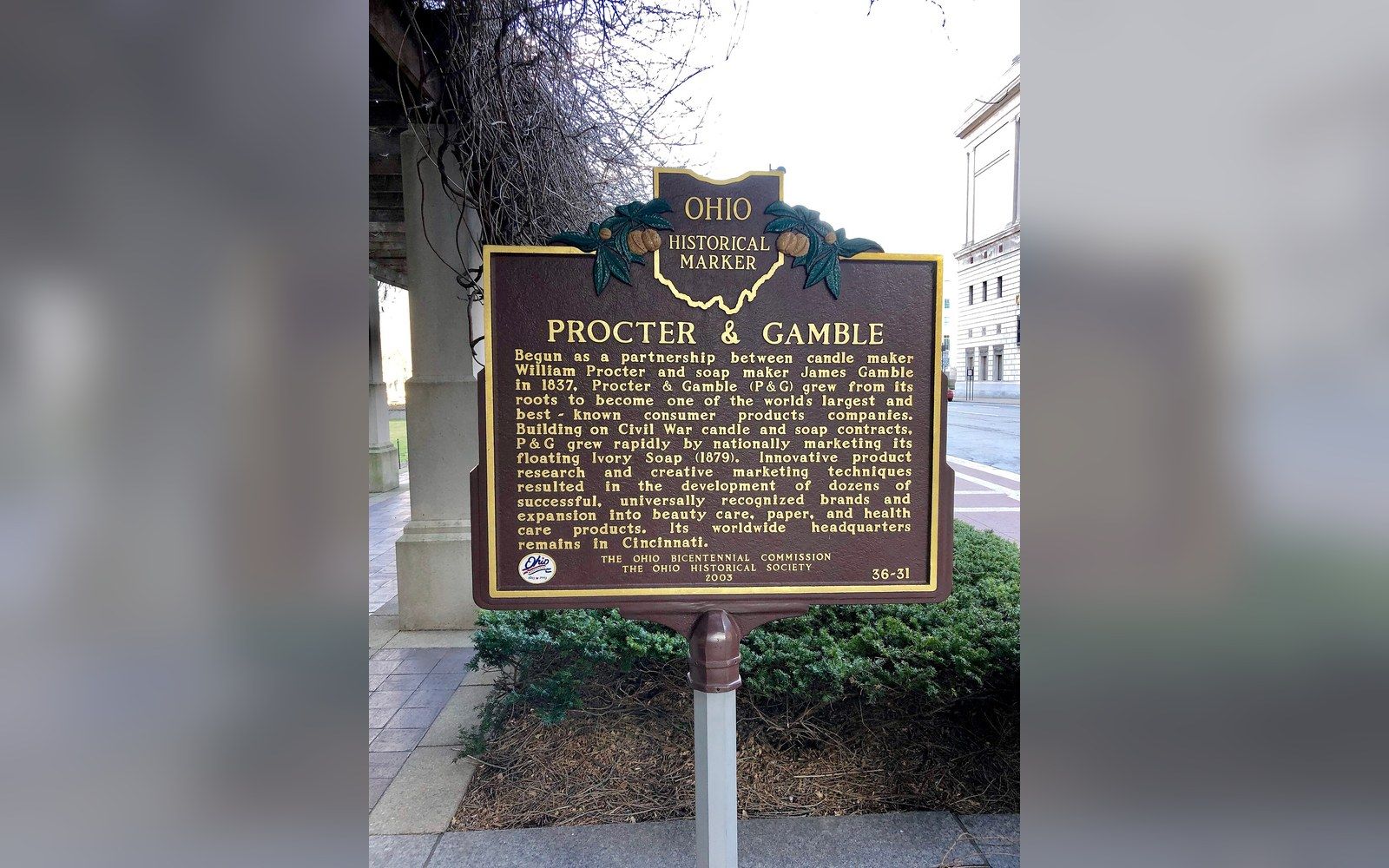
William Procter and James Gamble were persuaded by their shared father-in-law, Alexander Norris, to combine their soap and candle operations in Cincinnati in 1837.
Photo: Historical Marker, Procter and Gamble World Headquarters, Cincinnati, OH · Wikimedia CommonsHow Alexander Norris talked his sons-in-law into a partnership — and why Cincinnati's slaughterhouses made the argument for him
The City That Made the Deal Inevitable
By the mid-1830s Cincinnati had earned a nickname that was half boast and half complaint. Porkopolis — the title stuck because it was accurate. Hog drives arrived from across the Ohio Valley every autumn, and the slaughterhouses along the Mill Creek basin processed them by the tens of thousands each season. The fat that came off those hogs had to go somewhere. Soap and candle makers bought it, rendering the lard into the oils and tallow their products required. The city's geography had already conspired to make this workable: the Ohio River's northward bend set Cincinnati on a natural terrace with direct water access south and east, meaning anything a factory produced could reach New Orleans, Pittsburgh or the Gulf Coast without an overland leg. Raw material was cheap and abundant; the market was continental. The only question was whether anyone was organised enough to seize it at scale.
William Procter had arrived from England by way of New York, trained as a candlemaker, and settled in Cincinnati around 1832. James Gamble came from Ireland, had learned soap-making in the United States, and was operating in the same city at roughly the same moment. The coincidence that both men married daughters of a Cincinnati candle dealer named Alexander Norris belongs to the city's habit of concentrating its trades in tight social circles — but Norris did more than give them wives. Around 1837, recognising that his two sons-in-law were drawing on the same lard suppliers and selling into overlapping markets, he argued the obvious: they were competitors who would do better as partners. The advice was pragmatic rather than sentimental, and both men accepted it. The partnership was formalised on 31 October 1837, with each contributing roughly equal capital to the new enterprise of Procter & Gamble ↗.
Lard, River and the Logic of Scale
The founding conditions deserve attention because they shaped everything that followed. Cincinnati's pork-processing industry, which by the 1840s was the largest in the world, generated animal fats as a byproduct that nearby factories could obtain far below the cost faced by competitors in eastern cities. Procter & Gamble ↗ exploited this structural advantage from the start, keeping input costs low while the Ohio River gave their finished goods a freight route that a land-locked competitor could not match. Findlay Market, which opened in 1852 on land donated by James Findlay, captures how densely integrated Cincinnati's provisioning trades had become by mid-century: butchers, fat traders and soap raw materials all moved through the same commercial fabric.
The firm grew steadily through the 1840s and 1850s, supplying candles and soap to regional markets. The Civil War provided a sudden, enormous contract: Procter & Gamble supplied the Union Army with soap and candles, and soldiers who used the product during the war carried its name back to their home states afterward. That wartime exposure built national brand recognition before national advertising existed as a formal discipline. By the time the conflict ended, the company was no longer simply a Cincinnati firm serving river towns — it had demonstrated the capacity to fulfill orders at a scale most American manufacturers could not approach.
The candle side of the business faced a structural threat once kerosene lamps became widespread after the 1860s and then electric lighting began its slow spread through American homes. A company that had organised itself partly around tallow candles needed to find a product that would carry it forward. That pressure, combined with the firm's accumulated knowledge of fat chemistry, pointed toward soap — specifically toward a soap that could be marketed directly to consumers rather than sold in bulk to institutions or retailers who would rebrand it.
Porkopolis — the title stuck because it was accurate.
The Moment the Company Became Something Else
The Ivory Soap launch of 1879 is the pivot on which the firm's modern identity turned. The product had a specific technical property — a fat-to-lye ratio that trapped air and made the bar float — and that property became its marketing proposition. The floating soap was easier to find in a murky washbasin, a practical advantage in an era when indoor plumbing was still irregular and bathing often happened in shared or dim conditions. The brand name came from a reading of the forty-fifth Psalm — "all thy garments smell of myrrh and aloes and cassia, out of ivory palaces" — and the phrase that accompanied it in advertising, claiming the soap was 99 and 44/100 percent pure ↗, entered American commercial language as one of the most durable product claims of the nineteenth century.
What mattered beyond the soap itself was what Procter & Gamble did with it commercially. The firm invested in national newspaper advertising at a moment when most consumer goods manufacturers still relied on word of mouth or local placards. They packaged Ivory in consistent, recognisable wrappers. They sold it to individual consumers by name rather than allowing retailers to cut bulk soap into unmarked portions. These decisions — brand consistency, direct-to-consumer messaging, the idea that a manufactured good could carry a personality — were not invented by Procter & Gamble, but the company pursued them with a thoroughness that set a template other industries would study for decades. The University of Cincinnati's collections document the company's later role in shaping market research methodology, but the strategic instinct visible in the Ivory campaign of 1879 came first.
The Cincinnati that made this possible was already changing. The slaughterhouses that had supplied cheap lard were losing their dominance to Chicago, where rail-linked stockyards were assembling a pork industry that would eventually dwarf what the Ohio River towns had built. Procter & Gamble adapted by broadening its fat sourcing, developing synthetic and vegetable-oil inputs over the following decades, and shifting the centre of gravity from the rendering yard to the chemistry laboratory. The city's Over-the-Rhine district and the basin around it remained the physical heart of the operation through the nineteenth century, the firm's factories occupying a portion of the same industrial landscape where the pork trade had first made the partnership's founding logic so compelling.

Tom and John Kiradjieff opened Empress Chili in 1922 near the Empress Burlesque theatre, serving a Macedonian-spiced meat sauce over spaghetti
Photo: Alberta Studios / PexelsWilliam Procter died in 1884; James Gamble died in 1891. By then the firm they had built on Alexander Norris's practical suggestion employed hundreds of people and was operating well beyond the regional soap trade the two men had originally occupied. The 1837 partnership agreement — signed in a city whose primary industry was killing hogs and whose primary asset was a bend in a river — had produced, by the time both founders were gone, one of the largest consumer goods companies in the United States. The lard barrels and the tallow vats that made it possible have long since vanished from the Cincinnati riverfront. The company's headquarters remain in downtown Cincinnati. The founding is still dated to October 1837 and still traced to the judgment of a father-in-law who noticed that two competitors were buying from the same suppliers.
From the record
Chronology
- 1832William Procter settles in Cincinnati
- 1837 (31 October)Procter & Gamble partnership formalised
- 1840s–1850sfirm supplies regional soap and candle markets
- Civil War eraUnion Army contracts extend national reach
- 1879Ivory Soap launched, with "99 and 44/100 percent pure" campaign
- 1884William Procter dies
- 1891James Gamble dies
Elsewhere on the site


From the record
Key figures
- William ProcterEnglish-born candlemaker, co-founder
- James GambleIrish-born soap-maker, co-founder
- Alexander NorrisCincinnati candle dealer; father-in-law to both men and architect of the partnership
More in Porkopolis