Section 2 of 6
Porkopolis
The industries, companies and foods that grew from a city processing half the country's hogs by 1843.
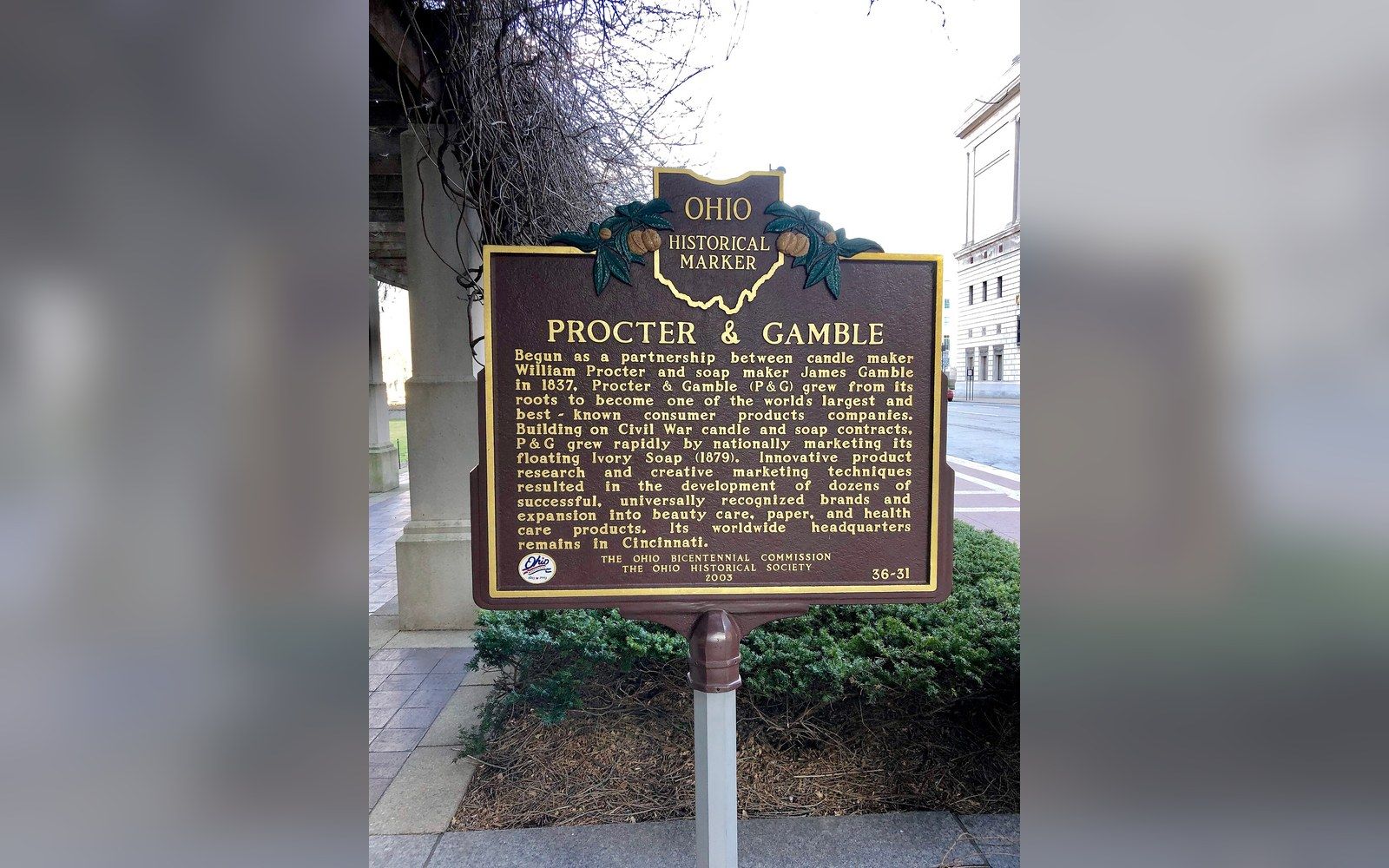
Two Brothers-in-Law and a Candle Factory, 1837 — the piece this section opens with.
Photo: Historical Marker, Procter and Gamble World Headquarters, Cincinnati, OH · Wikimedia Commons6 pages in this section
- Two Brothers-in-Law and a Candle Factory, 1837William Procter and James Gamble were persuaded by their shared father-in-law, Alexander Norris, to combine their soap and candle operations in Cincinnati in 1837. Covers the founding conditions — the pork-rendering industry supplying cheap lard, the river giving them a national market — and the Ivory Soap launch of 1879 as the moment the company became something larger.
- Barney Kroger's Single Rule: Never Sell What You Can MakeBarney Kroger opened his first grocery on Pearl Street in Cincinnati in 1883 with $372 borrowed capital and one operational principle — own the bakery behind the shop. This piece traces the chain's Cincinnati origins, its early vertical integration and its move to 1014 Vine Street.
- Empress, 1922: the Stew That Renamed ItselfTom and John Kiradjieff opened Empress Chili in 1922 near the Empress Burlesque theatre, serving a Macedonian-spiced meat sauce over spaghetti in ways — two-way, three-way, four-way — that have no equivalent elsewhere. Covers the recipe's Macedonian origins, the way-system, and the founding of Skyline in 1949 by Nicholas Lambrinides, a former Empress cook.
- What the German Butchers Did with the Pin OatsGoetta — pork and beef bound with steel-cut oats, sliced and pan-fried — arrived with Cincinnati's nineteenth-century German immigrant population and remained almost entirely local until Glier's Meats of Covington began commercial production in 1946. Covers the dish's German origins, its geography (concentrated in the old German neighbourhoods) and why it never spread.
- The French Pot and the Chip That Shouldn't WorkGraeter's has produced ice cream by the French pot process — a two-gallon spinning cylinder that produces intense density — since Louis Charles Graeter opened on Sycamore Street in 1870. Covers the French pot method, the black raspberry chocolate chip product that emerged from it, and why the chip-before-flavour layering technique is native to the process.
- Lager in the Basin: the Breweries the Eighteenth Amendment FinishedBy 1890 Cincinnati had more than thirty breweries, the largest being Christian Moerlein's on Elm Street; Prohibition ended most of them, with Hudepohl surviving as one of two post-Repeal operations of scale. Covers the German lager tradition in the basin, the Moerlein and Hudepohl operations, and Rhinegeist's founding in 2013 in the former Moerlein bottling plant on Elm Street.
The other five