The French Pot and the Chip That Shouldn't Work
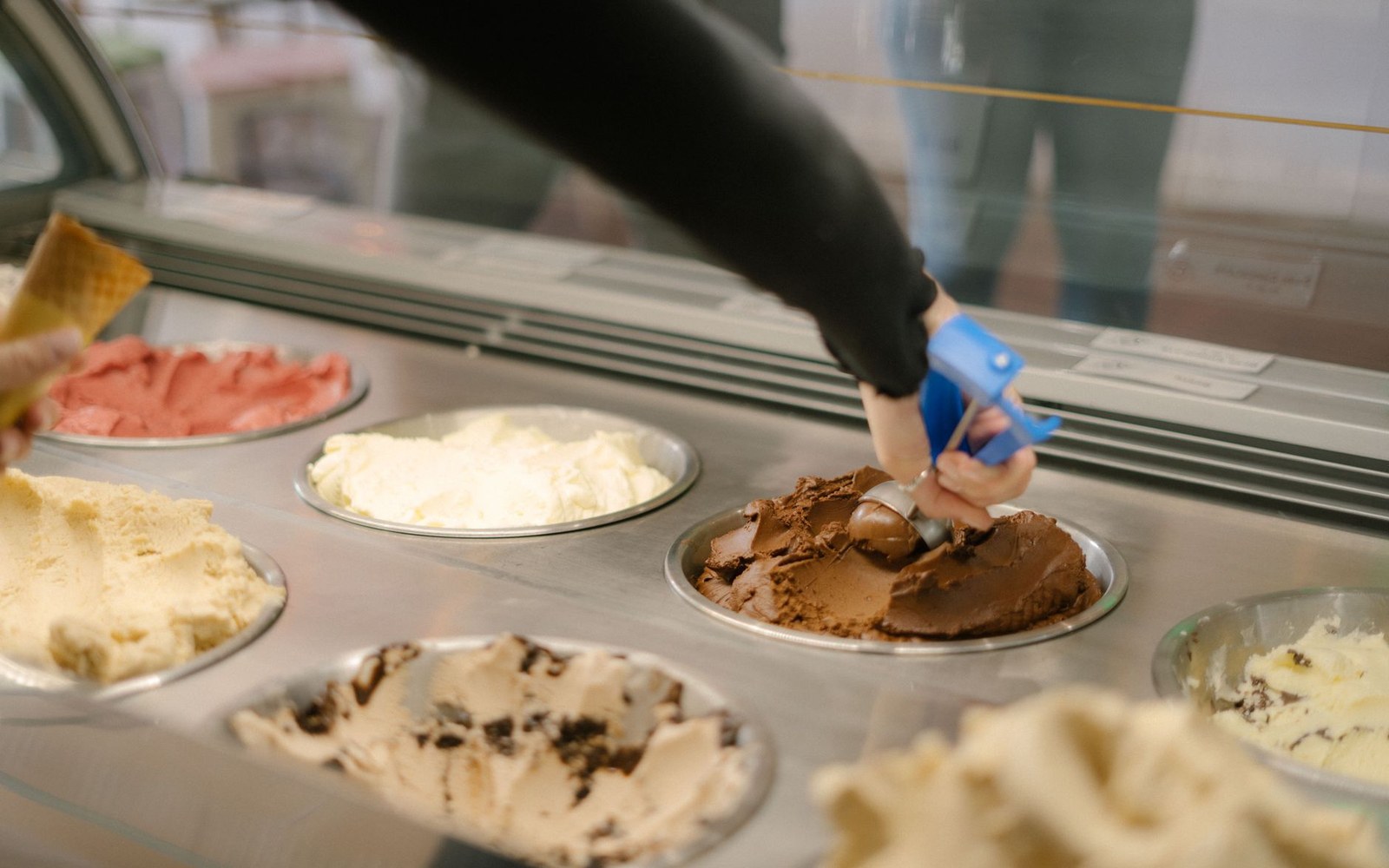
Graeter's has produced ice cream by the French pot process — a two-gallon spinning cylinder that produces intense density — since Louis Charles Graeter opened on Sycamore Street in 1870.
Photo: Hc Digital / PexelsA two-gallon spinning cylinder explains why Graeter's chocolate pieces shatter rather than snap.
The Machine Behind the Density
Louis Charles Graeter opened his first ice-cream operation on Sycamore Street in 1870, and the equipment he used then is, in its essential mechanics, the equipment the company uses now. The French pot process — a two-gallon spinning cylinder set into a tub of salt and ice, rotated slowly until the mixture freezes against the metal wall and is scraped back into the centre — produces ice cream in such small batches and with so little incorporated air that the finished product is measurably denser than factory-made alternatives. Where most commercial ice cream is churned in continuous freezers that push air through hundreds of gallons at once, a French pot turns out roughly two gallons per cycle. The result sits in the bowl with a weight that forks and spoons feel before the mouth does.
The technical term for incorporated air in ice cream is overrun — the percentage by which volume increases over the original liquid mix. Industrial products routinely run at 50 to 100 percent overrun. The French pot method, because the cylinder is small and the rotation slow, keeps overrun low enough that Graeter's ↗ has described its product as among the densest produced commercially in the United States. That density is not an affectation; it is the direct physical consequence of a batch size that has not changed in a century and a half.
The Chip That Comes First
The signature product — black raspberry with chocolate chips — is an artifact of the French pot's quirk rather than a decision made at a flavour-development table. Because each batch freezes from the outside of the cylinder inward, there is a moment mid-cycle when the interior is still semi-liquid and the walls carry a thick frozen layer. Graeter's fills that moment by pouring melted dark chocolate directly into the spinning cylinder. The chocolate hits the cold cream, shatters on contact with the frozen wall, and is churned through the mixture in irregular shards rather than uniform discs. The chip, in other words, is made inside the ice cream rather than added to it — which is why each piece is a different size, why some are thin as a wafer and others thick as a fragment of bark, and why they shatter rather than snap when bitten ↗.
A conventional chip deposited into a churning batch of ice cream meets a product that is already nearly frozen and simply distributes itself by tumbling. The French pot chip is formed by the process itself. The sequence is inverted: chocolate before texture, structure before flavour. It works because the semi-liquid window — the gap between partial and full freeze — is wide enough in a two-gallon batch for the molten pour to disperse before the cylinder completes its rotation. In a large continuous freezer, the thermal dynamics would not allow it; the chocolate would seize in clumps or coat the machinery.
Black Raspberry's Particular Logic
The pairing of black raspberry with chocolate is not arbitrary. Black raspberry is one of the most acidic of the common berry flavours, and that acidity cuts cleanly through the fat density that the French pot process produces. A milder flavour — vanilla, say, or strawberry — risks being swallowed by the texture before it registers on the palate. Black raspberry arrives loudly enough to match what the French pot makes. The colour also helps: the deep red-purple of the base makes the irregular dark shards visible before the spoon reaches the mouth, which means the eater anticipates the textural contrast rather than being surprised by it. Anticipation, in food, is part of the experience.
Graeter's has remained family-owned across generations, and the French pot process was retained not as a heritage statement but as the operational basis for the product's character. Remove it, and the chip-formation technique disappears with it. The shards become discs, the density becomes lightness, and the thing is a different object entirely.
The result sits in the bowl with a weight that forks and spoons feel before the mouth does.

Barney Kroger opened his first grocery on Pearl Street in Cincinnati in 1883 with $372 borrowed capital and one operational principle — own the bakery behind the shop. Barney Kroger's Single Rule: Never Sell What You Can Make
Photo: Kroger store penny circulation · Wikimedia CommonsFrom the record
The process, step by step
- French pottwo-gallon rotating cylinder; freezes from the outside wall inward
- Salt-and-ice tub surrounds the cylinder; no mechanical refrigeration in the original method
- Overrunthe air-incorporation percentage; kept low by the small batch and slow rotation
- Semi-liquid windowthe mid-cycle phase when chocolate is poured into the spinning batch
From the record
Key facts
- Sycamore Streetlocation of Louis Charles Graeter's first operation, 1870
- Batch sizeapproximately two gallons per French pot cycle, unchanged in principle since founding
- Chip formationchocolate poured molten into the cylinder mid-freeze, not added after
More in Porkopolis