Losantiville, 1788: the Name Nobody Kept
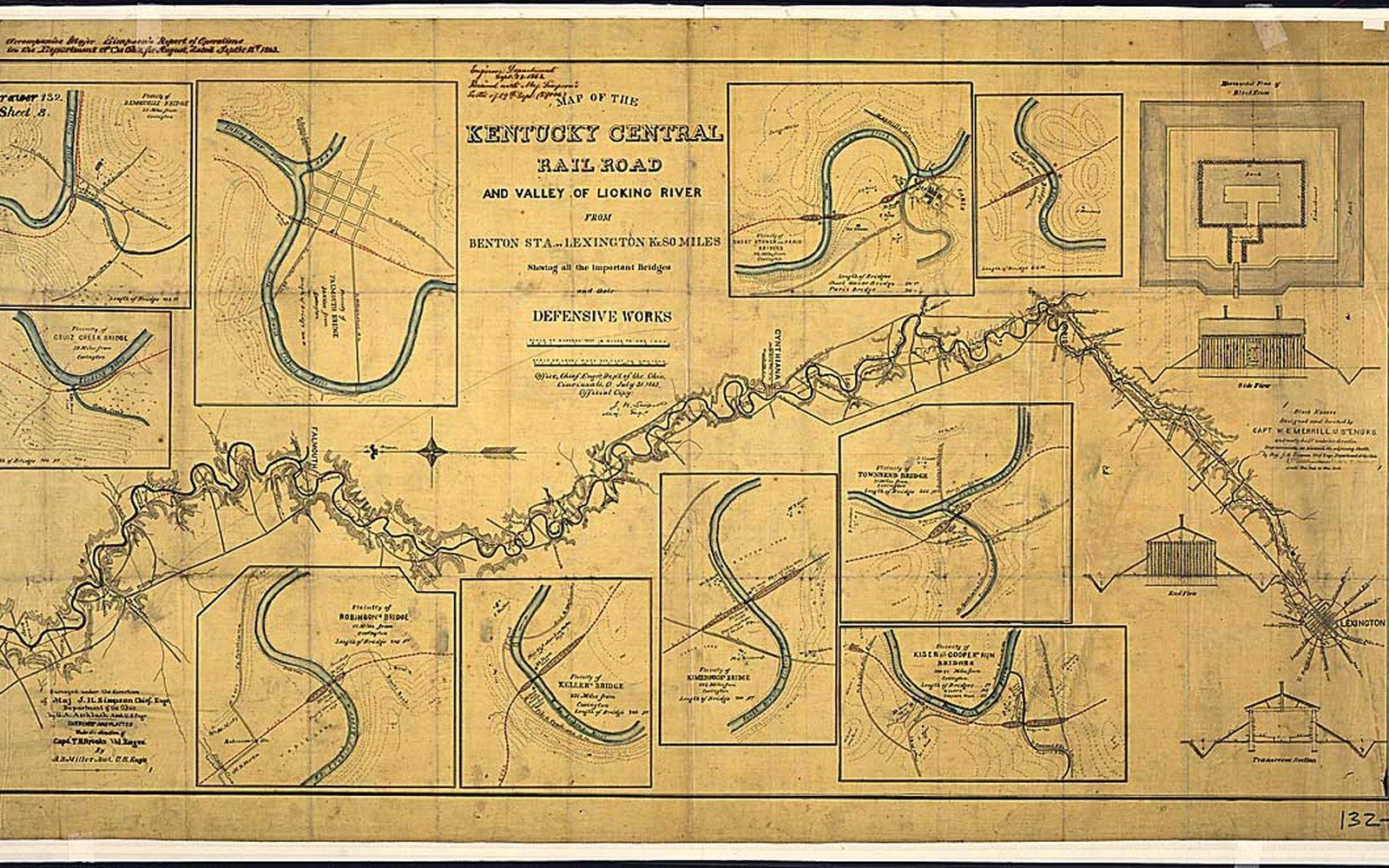
John Filson coined 'Losantiville' from a hybrid of English, Latin, Greek and French for the settlement opposite the Licking River mouth;
Photo: Map of the Kentucky Central Rail Road and Valley of Licking River from Benton Sta. to Lexington, Ky., 80 miles, Showing all the important Bridges and their Defensive Works. Surveyed under the direction of Maj. J. H(...) - NARA - 305765 · Wikimedia CommonsJohn Filson invented a word from four languages to name a settlement on the Ohio basin. Arthur St. Clair replaced it two years later with a single act of political flattery that proved permanent.
The Surveyor's Portmanteau
John Filson arrived in the Northwest Territory in 1788 as a surveyor and land speculator, a man with a talent for dramatic gesture. He had already published a celebrated account of Kentucky that introduced Daniel Boone to a reading public on two continents. Naming a new town was, for Filson, a literary act as much as a cartographic one.
The settlement he co-platted that year sat on the basin — the flat river terrace formed by the Ohio's northward bend — directly across the water from the mouth of the Licking River, where it empties into the Ohio from the Kentucky side. Filson wanted the name to say exactly that, and he built it from parts: L for Licking River, os from the Latin os (mouth), anti from the Greek anti (opposite), and ville from the French for town or settlement. The result was Losantiville — a hybrid of English geography, Latin, Greek and French, assembled into a word that described a precise geographic relationship: the town opposite the mouth of the Licking ↗.
It was ingenious, and it was almost immediately discarded. Filson himself disappeared that autumn, killed in a Native American ambush before the settlement had time to grow into its name. Without its inventor, the word had no advocate.
He had already published a celebrated account of Kentucky that introduced Daniel Boone to a reading public on two continents.
The Society's Claim
Arthur St. Clair reached the settlement in January 1790 as governor of the Northwest Territory. He was a former Revolutionary War officer and a member of the Society of the Cincinnati, the hereditary fraternal organization founded in 1783 for officers of the Continental Army and their descendants. The Society took its name from Lucius Quinctius Cincinnatus, the Roman farmer-general who, according to tradition, left his plough to save Rome and returned to it once the crisis had passed — an ideal the founding officers found flattering to their own self-image.
St. Clair organized a new county around the settlement and, in renaming it, paid tribute to the Society that connected him to his fellow officers. He called it Cincinnati. The gesture was neither subtle nor accidental: it placed the town within a network of Revolutionary-era prestige and signalled that its leading men belonged to a recognized order of the new republic. The Society of the Cincinnati ↗ had a legitimacy in 1790 that a four-language portmanteau word simply could not match.
Why Cincinnati Held
The name survived because the institution behind it had reach and continuity. The Society of the Cincinnati still exists — headquartered in Washington, D.C., at Anderson House — making it one of the oldest hereditary organizations in the United States. A name attached to a living institution is harder to dislodge than one attached to a dead surveyor's clever idea.
Henry Wadsworth Longfellow reinforced the name's cultural weight when his 1854 poem "Catawba Wine" addressed the city as the Queen City, a sobriquet that carried no trace of Filson's construction. By the middle of the nineteenth century, Cincinnati was simply Cincinnati — a name that read as Roman, as deliberate, as civic, and that said nothing at all about the mouth of the Licking River.
Losantiville survived only in local historical memory, a curiosity passed down through county histories and encyclopedia entries. The name appears occasionally on commemorative markers and in the collections of the Cincinnati History Library and Archives ↗, where Filson's surveying work and the early plat records document the founding moment more concretely than the discarded name ever could.
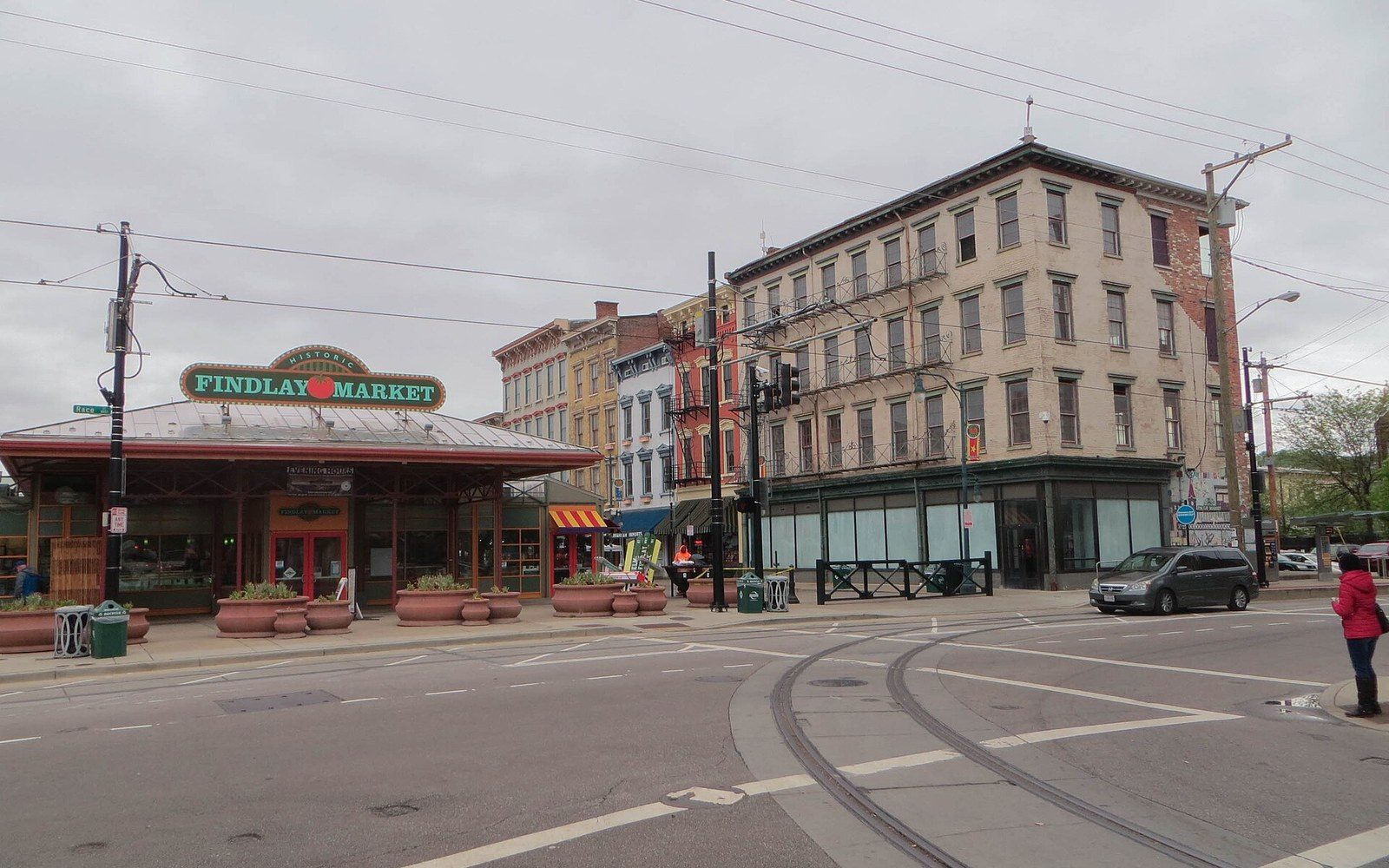
Ohio's oldest continuously operating public market opened in 1852 on land donated by James Findlay; Findlay Market Has Been Open Since Fillmore
Photo: 20170422 27 Elder & Race Sts - 36205942641 · Wikimedia CommonsWhat the episode preserves is a record of how place names actually work: accuracy loses to association, description loses to prestige, and the word that connects a settlement to a powerful network outlasts the word that merely tells you where you are. Filson's construction was more precise. St. Clair's was more useful. The Ohio terrace got the useful name, and kept it.
From the record
Chronology
- 1783Society of the Cincinnati founded by Continental Army officers
- 1788John Filson co-plats the settlement and coins "Losantiville"
- Autumn 1788Filson killed in ambush; the name loses its author
- January 1790Arthur St. Clair organizes Hamilton County and renames the town Cincinnati
- 1854Longfellow's "Catawba Wine" popularises "Queen City"
From the record
Name anatomy
- LLicking River (the geographic referent)
- osLatin for "mouth"
- antiGreek for "opposite"
- villeFrench for "town" or "settlement"
More in The Landing