From the Covington Anchorage, the Bridge Reads Differently
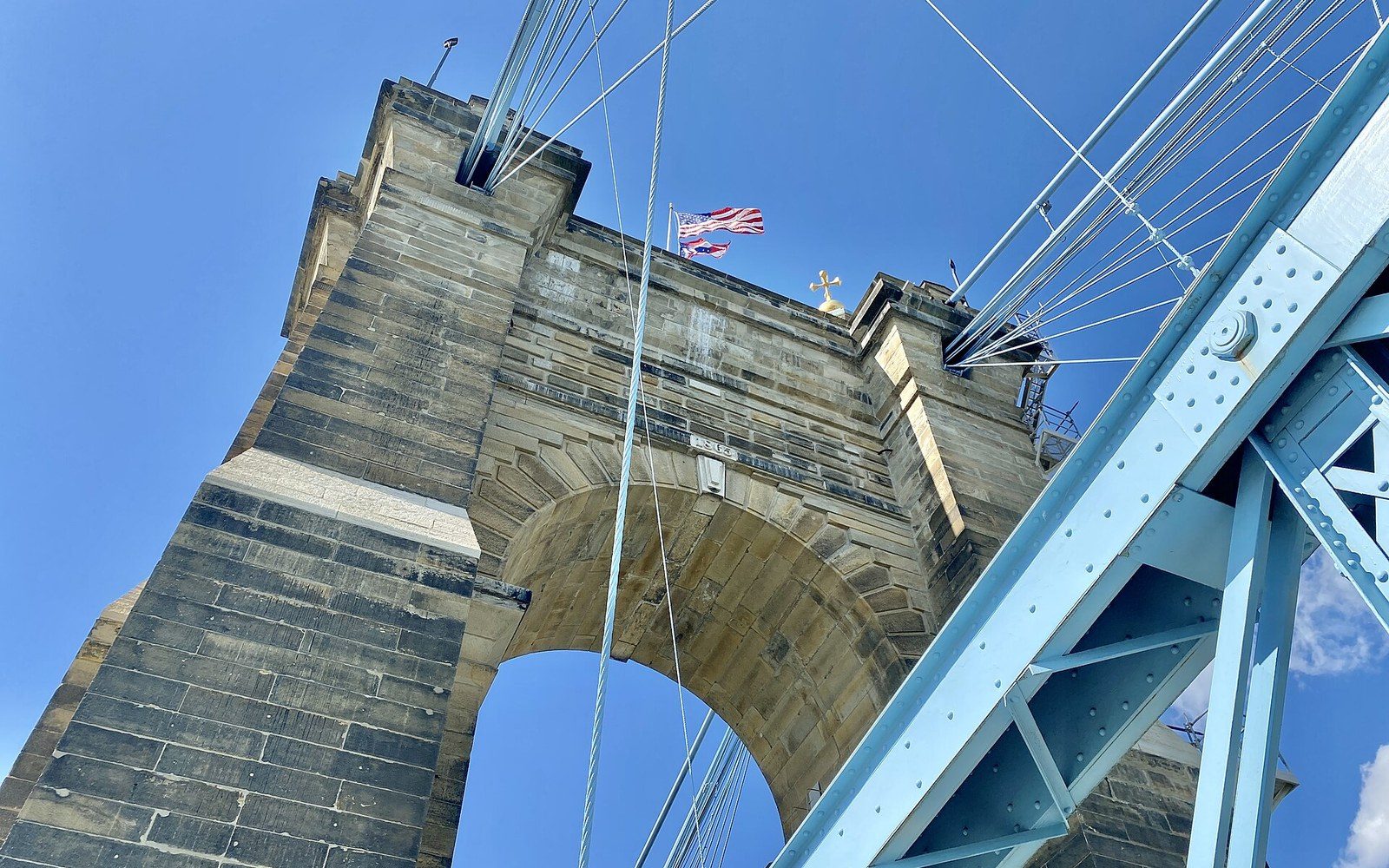
The Covington anchorage and approach to the Roebling Suspension Bridge present a different engineering reading from the Kentucky side — the Gothic towers rise above the approach.
Photo: Roebling Bridge, Covington, KY - 52280197590 · Wikimedia CommonsStand on the Kentucky bank and John Roebling's engineering logic opens up in ways the Cincinnati approach quietly hides.
What the South Bank Shows
The Cincinnati pedestrian who crosses and then turns around gets the better view. From the Covington anchorage, the Ohio River Suspension Bridge — completed in 1866 at a main span of 1,057 feet — resolves into a coherent system rather than a silhouette. The two Gothic limestone towers, each rising roughly 230 feet above high-water mark, read here as paired piers whose pointed arches were not merely decorative. Roebling chose the Gothic profile because the arch form directs the eye — and the structural logic — upward toward the cables, reinforcing rather than competing with the catenary overhead.
The Kentucky anchorage block is the element most visitors walk over without registering it. Buried beneath the Covington approach ramp is a massive masonry anchor that receives the main cables at the end of their run from the Cincinnati shore. The cable load is transferred into the ground through a system of anchor chains embedded in stone, a technique Roebling had refined by working with iron-chain anchorages on earlier projects. At Covington, the ground condition — compact glacial outwash above bedrock — allowed a shallower anchor pit than the Cincinnati side required, a detail that affected the approach geometry and explains why the Kentucky ramp meets the roadway deck at a slightly different grade.
The original toll structure stood on the Covington end. When the bridge opened in December 1866 under the Covington and Cincinnati Bridge Company, tolls were collected here before a traveller committed to the span. The toll plaza is long gone, but the footprint of the approach — narrowing where the collection booth once stood — remains legible in the street alignment on Second Street in Covington. Pedestrians paid one cent; horses and their riders, more.
The Cincinnati pedestrian who crosses and then turns around gets the better view.
Standing at the anchorage, the full cable geometry is also easier to read. Each main cable fans from a single point at the tower saddle and widens as it descends, the vertical suspender wires spaced closer together near the towers where the load is greatest — a distribution Roebling calculated to produce uniform tension across the deck ↗. From the Cincinnati side, perspective foreshortens this array; from Covington, it lies almost in elevation, and the engineering arithmetic becomes visible without a diagram.
The bridge Roebling used as his proof of concept for the Brooklyn Bridge ↗ rewards this reversal. Walk to Kentucky, then look back north — the Ohio bank is the monument; the Kentucky bank is where you understand it.
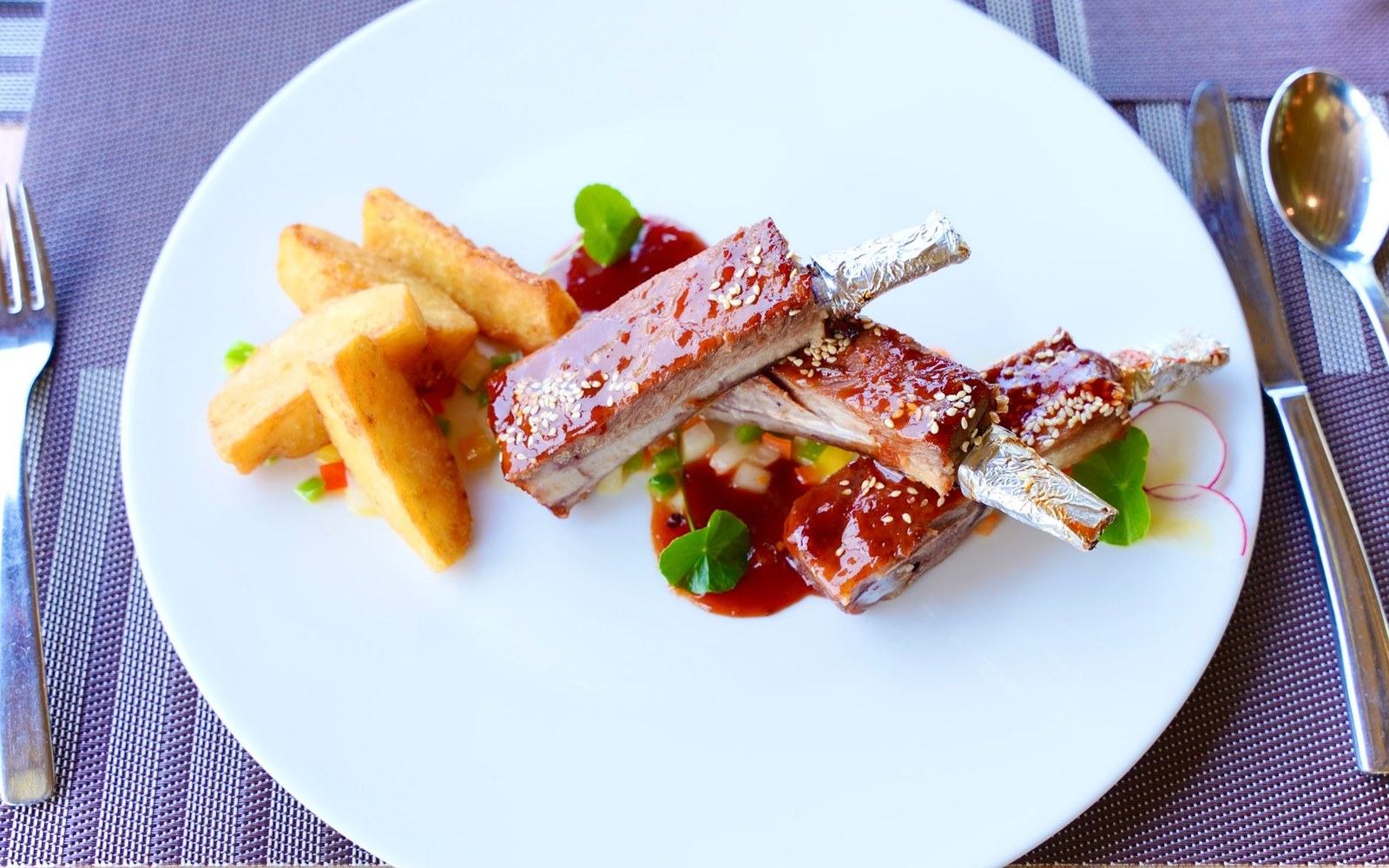
Montgomery Inn's Boathouse location on the Ohio riverfront in Cincinnati opened in 1989, extending a rib restaurant operation founded by Matilda Gracin in Montgomery, Ohio, in 1951; Montgomery Inn at the Boathouse: the Ribs and the River…
Photo: Khải Huyền Trương / PexelsFrom the record
Chronology
- 1866, Decemberbridge opens under the Covington and Cincinnati Bridge Company; tolls collected at the Covington end
- 1866main span of 1,057 feet makes it briefly the longest suspension bridge in the world
- Post-openingtoll plaza eventually removed; approach geometry survives in Second Street alignment
From the record
Engineering elements
- Gothic limestone towersroughly 230 feet above high-water mark; arch form echoes cable catenary
- Anchorage blockmasonry anchor receiving main cables; Kentucky side sits in glacial outwash, allowing shallower pit than Cincinnati anchorage
- Suspender wire spacingdenser near towers to distribute load uniformly across deck
- Cable saddlespoint where main cables transition from tower to anchorage run
More in Across the River